How much do ground-mounted solar systems cost in 2026?
Ground-mounted solar systems typically cost between $3.25 and $4.75 per watt in 2026, or about $500 to $1,000 more per kilowatt (kW) than rooftop solar systems. In states like Maine, New Hampshire, Massachusetts, Connecticut, New York, New Jersey, Maryland, Pennsylvania, and Rhode Island (RI, costs can vary based on site conditions, trenching distance, and system size.
2026 Tax Tip: While direct federal credits for cash-purchased home solar have shifted, you can still secure a 30% project discount via a Solar Lease or Prepaid Lease. 2026 plans leverage the 48E Federal Credit to keep your upfront costs low.
What is a ground-mounted solar system?
A ground-mounted solar system is installed directly on your property instead of on your roof. These systems are ideal for homeowners with large properties, poor roof conditions, or high energy usage requiring larger systems. Unlike older systems that require massive concrete pours, we use industrial-grade Helical Piers. These steel anchors are driven deep into the earth, providing superior wind resistance with a smaller environmental footprint.
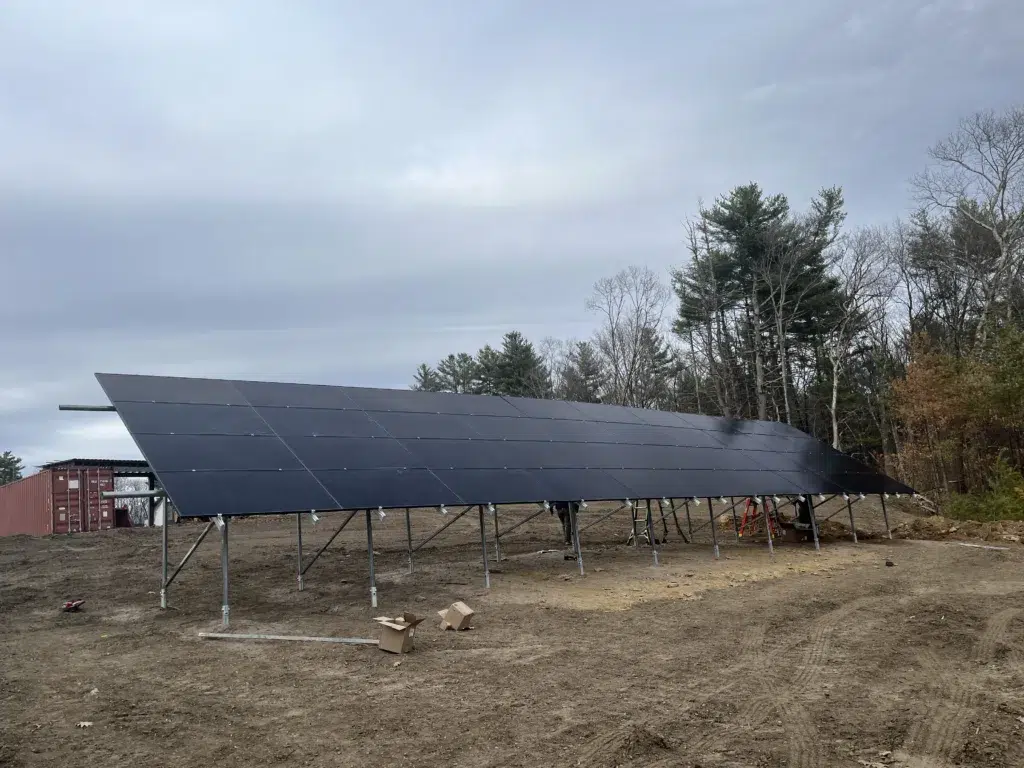
Ground mounts can produce 15–25% more energy than a roof because they aren’t limited by your home’s orientation and can be optimized for shading conditions.
Who is a good candidate for ground-mounted solar?
Ground-mounted solar is best for homeowners with ample land, roofs that are shaded or unsuitable, and those looking to offset high electricity usage. These systems are most common in rural and suburban areas across ME, NH, MA, CT, NY, NJ, MD, PA, and RI.
How much space do you need?
Most systems require at least 75 linear feet of open space. A typical 10 kW system needs approximately 30 ft by 20 ft, plus setbacks of 20–25 feet from property lines depending on local zoning.
What are the site requirements?
– Relatively flat land (slopes up to ~30 degrees)
– Clear, unobstructed installation area
– Accessible trenching path between system and home
– Adequate space for equipment and setbacks
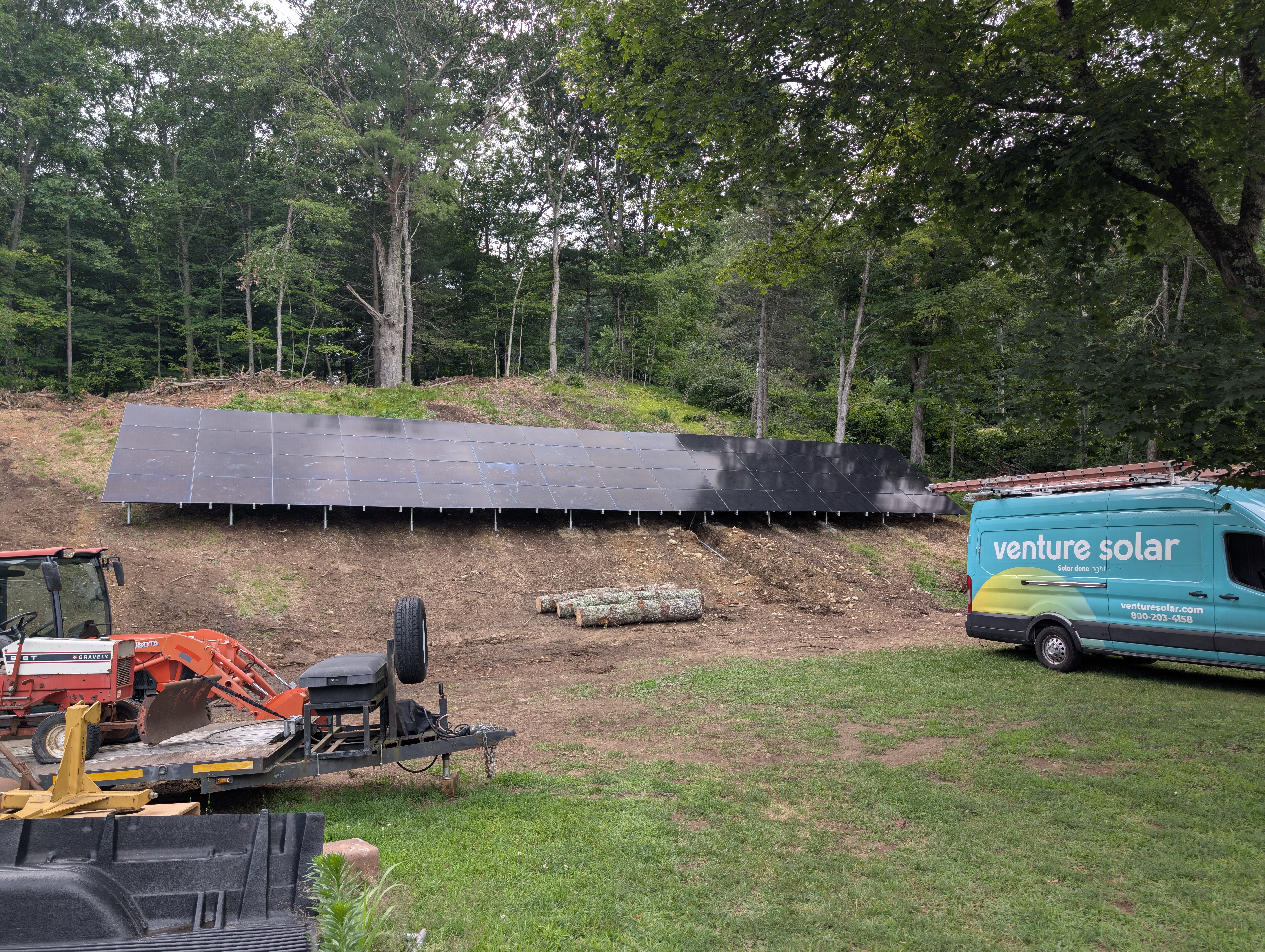
How are ground-mounted systems built?
Systems are typically installed four panels high in landscape orientation with a tilt of about 35 degrees. Common equipment includes Sunmodo racking and Tesla string inverters, which are ideal for unshaded environments.
What increases the cost of ground-mounted solar?
Key cost drivers include trenching distance to the home, terrain conditions, and equipment mobilization. There is additional racking versus a pitched rooftop where the racking system is installed on the natural slope of the roof. Special equipment is required for installation to drive the posts into the ground.
Larger ground mount systems benefit from economies of scale, reducing cost per watt. A primary cost driver is the electrical trench length. Expect $40–$50 per linear foot for professional digging, conduit, and heavy-gauge copper wiring. For systems located 100+ feet from the home, we optimize wire sizing to prevent efficiency loss.
Are ground-mounted solar systems worth it?
They are worth it if your roof cannot support solar or you need a larger system. They offer higher production potential, easier maintenance, and better long-term scalability.
| Feature | Rooftop Solar | Ground-Mounted Solar |
|---|---|---|
| Typical Cost | $2.75 – $3.75 / Watt | $3.25 – $4.75 / Watt (+$0.50 – $1.00 / Watt additional) |
| Foundation | Existing roof structure | Helical piers (driven piles) |
| Efficiency | Limited by roof angle | Optimal (35° fixed tilt) |
| Tax Credit | 25–35% via 48E lease options | ~25% via 48E lease options |
| Maintenance | Difficult access | Easy (ground-level access) |
Is ground-mounted solar more efficient?
Yes, because panels are installed at optimal tilt and orientation.
Can I install ground-mounted solar in my state?
Yes, but zoning rules vary by town in ME, NH, MA, CT, NY, NJ, MD, PA, and RI.
How long do systems last?
Typically 25–30 years or more.
Do they require maintenance?
Minimal, but easier to service than rooftop systems.
How much land is needed?
Usually 75+ feet of open space for optimal layout.